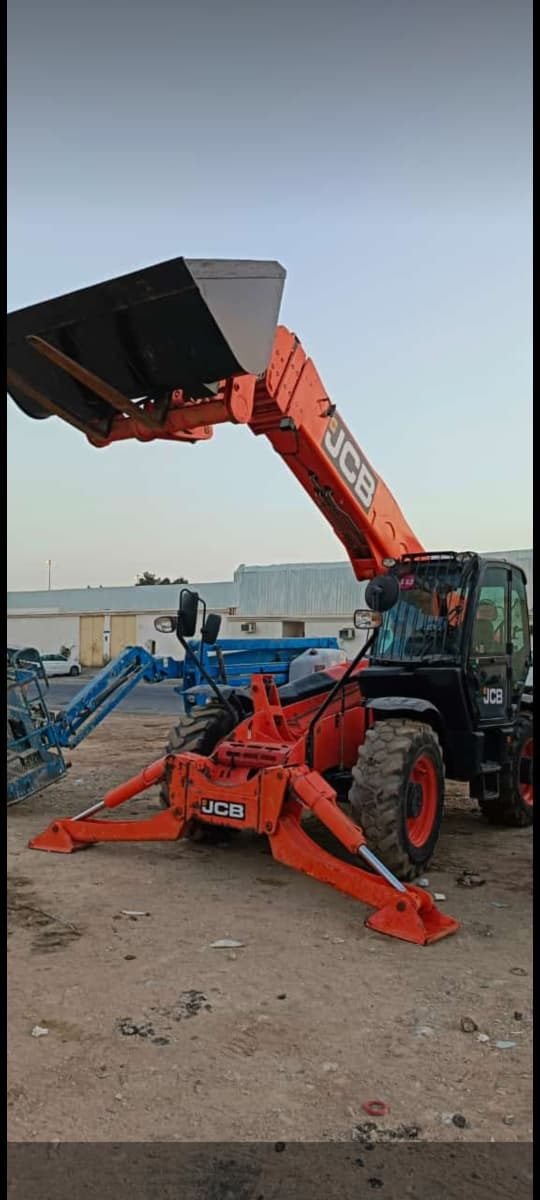
Al-Kamil Forklift Rental supplies telescopic handlers (telehandlers) that combine a forklift’s material-handling capability with a boom’s extended reach — the go-to machine for active construction sites that need to move material to upper floors or over obstacles repeatedly throughout the day.
Telehandler Rental Overview
A telehandler looks like a forklift but works more like a compact crane: its telescoping boom extends up and outward, letting it place loads at height and distance that a standard forklift’s vertical mast simply cannot reach. This makes it the standard equipment choice on multi-story construction sites, where material needs to move from ground level to upper floors continuously as work progresses, and where a full crane would be overkill for the load sizes involved.
Telehandler vs. Forklift
A standard forklift lifts straight up along a vertical mast and is best suited to warehouse and yard material handling on a single level. A telehandler’s extending boom reaches both up and outward, letting it deliver material to elevated or set-back positions a forklift’s mast geometry can’t reach at all. If your site is single-level and materials move horizontally rather than vertically, a forklift is the more efficient and economical choice; if material needs to go up to another floor or over an obstacle, a telehandler is the right tool.
Telehandler vs. Crane
For loads within a telehandler’s capacity and reach, it’s a faster, more flexible, and more economical choice than bringing in a crane — no licensed-operator requirement in the same regulatory sense, faster setup, and the ability to reposition quickly around an active site. Once your load exceeds telehandler capacity or needs precision placement at extreme height or radius, a crane becomes the appropriate — and necessary — choice instead.
Attachments and Versatility
Beyond standard forks, telehandlers commonly run buckets, winches, and work platforms, making them genuinely multi-purpose machines on an active construction site rather than single-task equipment. If your project needs this kind of flexibility across different phases, tell us the range of tasks you’re expecting and we’ll confirm which attachments are available for the unit we recommend.
Rental Terms & Pricing
Daily, weekly, and monthly rental terms are available, with monthly contracts — the most common choice for active construction sites — offering the lowest effective daily rate and typically including scheduled maintenance. Every quote separates the rental rate, delivery cost, and operator fee (if requested) into clear line items.
Common Applications
Construction contractors use telehandlers as a daily-use workhorse for moving block, rebar, and material pallets to upper floors throughout a build. Agricultural and industrial yard operations use them for bulk material handling with bucket attachments. And facilities teams occasionally use telehandlers for heavier maintenance lifts beyond a standard forklift’s reach but not requiring a full crane.
Frequently Asked Questions
Do I need a licensed operator for a telehandler?
Telehandlers don’t require the same government licensing as cranes, but operators should be properly trained on the machine’s specific controls and load charts. We can supply a trained operator or confirm your team’s readiness at handover.
What’s the typical lift capacity of a telehandler?
This varies significantly by model and boom extension — tell us your typical load weight and required reach, and we’ll recommend a unit with an appropriate capacity margin.
Can a telehandler replace a crane on my site?
For loads within its capacity and reach, often yes, at lower cost and faster setup. For heavier or more precise lifts, a crane remains the safer and more appropriate choice.
Get a Telehandler Rental Quote
Tell us your typical load, required reach, and project duration via WhatsApp or call +966 55 936 2375 for a clear quote.
Ground Conditions and Stability
Telehandlers extend significant weight outward from their base, which makes stable, load-bearing ground at the operating position essential — especially at full boom extension. On active construction sites with recently backfilled or disturbed ground, confirm with our team whether outrigger pads or additional ground preparation are needed before operation begins, rather than discovering a stability issue mid-lift.
Common Capacity and Reach Classes
Telehandlers are generally grouped by lift capacity (commonly 2.5 to 4 tons for standard construction models) and maximum lift height (typically 6 to 18 meters, depending on the model). Compact-frame telehandlers suit tighter urban construction sites where maneuverability matters as much as reach; larger-frame units suit open sites where maximum lift height and capacity take priority. Tell us your site’s spatial constraints alongside your load and reach requirements, and we’ll factor maneuverability into the recommendation, not just raw specification numbers.
Built for Active Construction Ground
Telehandlers are designed from the ground up for construction-site conditions — large, aggressive tires, four-wheel drive, and a chassis built to handle uneven, unpaved terrain that would challenge a standard forklift. This is part of why they’ve become the standard material-handling machine on active builds rather than a specialty piece of equipment: they’re simply built for the ground conditions construction sites actually have, not the smooth warehouse floors forklifts were originally designed around.
Fleet Availability and Delivery
Telehandlers are among our most requested pieces of equipment for active construction projects, and we maintain fleet availability accordingly across our covered cities. For projects with a firm start date, booking a week or more ahead gives you the best selection of capacity and reach classes; for urgent needs, contact us directly and we’ll confirm the fastest available option for your site.