Home » Knowledge Center » Boom Lift Rental in Saudi Arabia: Everything You Need to Know
Boom Lift Rental in Saudi Arabia: Everything You Need to Know
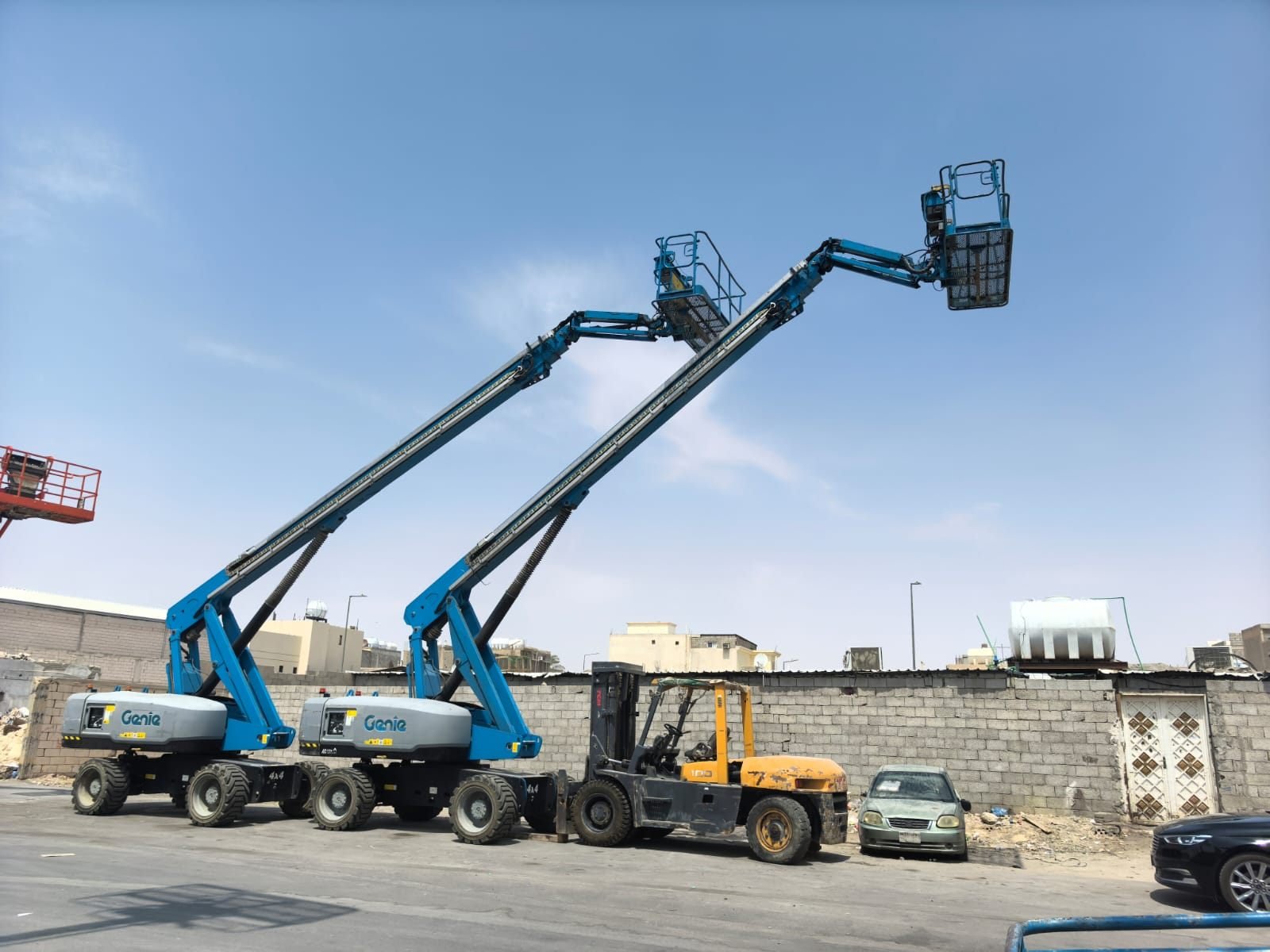
Boom lifts give workers extended, angled reach that scissor lifts and standard ladders simply can’t match, making them essential for facade work, utility maintenance, and construction tasks around obstacles across Saudi Arabia. This guide covers the two main boom lift configurations, how to choose between them, and what to check before booking one for your project.
On This Page
- How Boom Lifts Work
- Articulating vs. Telescopic Boom Lifts
- When a Boom Lift Is the Right Choice
- Understanding Height and Horizontal Reach
- Terrain and Site Conditions
- Safety Considerations
- Rental Cost Factors
- Common Industries and Applications
- FAQ
How Boom Lifts Work
A boom lift raises a small platform on the end of a hydraulic arm, allowing it to extend both upward and outward from its base rather than moving in a straight vertical path like a scissor lift. This extended, angled reach lets operators access locations positioned over obstacles, at a horizontal distance from the vehicle’s footprint, or around architectural features that a straight-up lift couldn’t reach. The tradeoff is a smaller platform, typically designed for one or two workers, compared to the larger, more spacious platform a scissor lift offers.
Articulating vs. Telescopic Boom Lifts
Articulating boom lifts feature multiple jointed sections that bend at knuckle points, giving the arm the ability to reach up, over, and around obstacles in a way a straight arm cannot, which makes them ideal for navigating tight or congested sites. Telescopic boom lifts extend in a single straight line, offering greater maximum horizontal reach and typically higher platform capacity, making them the better choice when you need to reach a specific point at distance without obstacles in the way. Choosing between the two comes down to your site layout: congested sites with obstacles favor articulating booms, while open sites requiring maximum straight-line reach favor telescopic models.
When a Boom Lift Is the Right Choice
Boom lifts are the right tool whenever your task requires reaching over an obstacle, working at a horizontal distance from a fixed base position, or accessing an area a straight vertical lift can’t reach, such as over a rooftop edge, around existing equipment, or above a sloped or landscaped area where a scissor lift’s base can’t be positioned directly beneath the work point. If your task sits directly above where the lift can be parked, a scissor lift is usually simpler and more cost-effective, so boom lifts are best reserved for situations that genuinely need their extended reach capability.
Understanding Height and Horizontal Reach
Boom lift specifications list both maximum platform height and maximum horizontal outreach, and both figures matter for planning your task. A lift with a high platform height but limited horizontal reach won’t help if your work point sits well away from where the vehicle can be positioned, so always calculate both the vertical and horizontal distance to your actual work point before selecting a model. Larger telescopic boom lifts can offer horizontal reach exceeding 20 meters, which opens up work possibilities that would otherwise require scaffolding or a completely different access method.
Terrain and Site Conditions
Rough-terrain boom lifts, built with larger tires and more robust stabilization systems, are standard for outdoor construction sites with uneven ground, slopes, or soft surfaces. Electric boom lifts suit indoor or smooth, level outdoor surfaces where quiet, emission-free operation is valued, such as around occupied buildings or indoor high-ceiling spaces. Ground conditions directly affect boom lift stability given how far the platform can extend from its base, making terrain assessment even more critical for boom lifts than for scissor lifts.
Safety Considerations
Because boom lifts extend outward from their base, fall protection harnesses are standard practice for platform operators, unlike scissor lifts where guardrails alone are often considered sufficient given the more contained platform movement. Wind speed limits are also a critical safety factor for boom lifts, since extended booms are more susceptible to wind-related instability than compact scissor lift platforms. Operators should be specifically trained and certified on boom lift operation, since the controls and stability considerations differ meaningfully from other aerial platform types.
Rental Cost Factors
Boom lift rental rates are generally higher than equivalent-height scissor lifts, reflecting their more complex hydraulics and the added engineering required for extended reach capability. Telescopic models with greater maximum reach typically command a premium over articulating models of similar platform height. As with other aerial equipment, monthly rental terms offer better value than short daily bookings, and delivery distance along with whether an operator is included will factor into your final quote.
Common Industries and Applications
Construction contractors use boom lifts extensively for facade installation, structural steel connections, and exterior finishing work on multi-story buildings. Telecommunications and utility companies rely on boom lifts to access rooftop equipment, power lines, and infrastructure positioned away from convenient ground access points. Facilities management teams use boom lifts for tree trimming, exterior lighting maintenance, and building envelope inspections that require reaching around architectural features. Event companies also use boom lifts for rigging and installation work at outdoor venues where a straightforward vertical lift wouldn’t reach the required positions.
Frequently Asked Questions
What’s the difference between articulating and telescopic boom lifts?
Articulating booms have jointed sections that bend around obstacles, while telescopic booms extend in a straight line for greater maximum horizontal reach.
Do boom lift operators need special certification?
Yes, boom lift operation requires specific training given the different stability and control considerations compared to scissor lifts or forklifts.
Can boom lifts work in windy conditions?
Only within manufacturer-specified wind speed limits, since extended booms are more sensitive to wind than compact vertical platforms.
Related Resources
Boom Lift Rental Hub | Scissor Lift Rental Guide | Man Lift Rental Guide
Need a boom lift for your project? Contact our team to check availability and get a quote.
Boom Lifts on Large-Scale Saudi Projects
Saudi Arabia’s active pipeline of giga-projects and large-scale infrastructure developments has driven significant demand for boom lifts capable of servicing complex, multi-level structures with irregular geometry. On these sites, the ability to navigate around structural elements, reach elevated positions at a horizontal distance, and service multiple work points without repositioning the base vehicle makes boom lifts particularly valuable compared to more limited access methods. Contractors on these projects often hire a mixed fleet of articulating and telescopic booms to cover both congested interior work and open exterior facade access from a single equipment pool.
Operator Training and Certification Standards
Boom lift operators in Saudi Arabia should hold certification specific to aerial work platforms, with training covering pre-use inspection, safe operating procedures, fall protection use, and emergency lowering procedures in case of a control system failure. Given the added complexity of a boom lift’s extended reach and multi-axis movement compared to a scissor lift, operator training typically takes longer and covers more scenarios, including how to respond if the platform becomes obstructed or loses power at height. Rental providers offering certified operators as part of their service remove the burden of sourcing and verifying this training from the renting business.
Delivery and Site Access Logistics
Larger boom lifts, particularly telescopic models with extended reach capability, have a significant footprint and weight that needs to be accounted for during delivery planning, including road access, gate widths, and any weight restrictions on site access routes or temporary bridging. Confirming these logistics with your rental provider ahead of delivery day, rather than discovering an access problem when the delivery truck arrives, avoids costly delays. For sites with genuinely constrained access, articulating boom lifts with a more compact transport footprint are often the more practical choice even if a telescopic model would otherwise offer more reach.
Fleet Maintenance and Inspection Standards
A well-maintained boom lift fleet should carry documented inspection records covering hydraulic systems, structural integrity of the boom sections, and safety interlocks, with these checks performed on a regular schedule rather than only at the point of rental. Ask any prospective provider how recently a specific unit was inspected and whether documentation is available on request, since this is a reasonable and standard question that a reputable provider will answer without hesitation. Given how much a boom lift’s safety depends on its hydraulic and structural systems functioning correctly at extended reach, this is one area where choosing the cheapest available option without checking maintenance standards carries real risk.
Confirming these details takes only a few minutes upfront and can prevent costly downtime or safety incidents later in your project.
Our team is happy to walk through recent inspection records and maintenance history for any unit before you commit to a booking.