Home » Knowledge Center » Scissor Lift Rental in Saudi Arabia: A Buyer’s Guide
Scissor Lift Rental in Saudi Arabia: A Buyer’s Guide
Scissor lifts are among the most widely used aerial work platforms in Saudi Arabia, valued for their stable, spacious platform and straightforward vertical reach. This guide explains how scissor lifts work, the main configurations available for rental, and the practical factors that should shape your decision before booking one for your project.
On This Page
- How Scissor Lifts Work
- Electric vs. Rough-Terrain Models
- Selecting the Right Platform Height
- Common Applications
- Floor Loading and Access Considerations
- Safety Essentials
- What Drives Rental Cost
- FAQ
How Scissor Lifts Work
A scissor lift uses a crisscrossing, folding support structure that extends vertically to raise a work platform directly above its base position. Unlike boom lifts, which can extend outward at an angle, scissor lifts move straight up and down, which gives them a larger, more stable platform footprint well suited to tasks requiring multiple workers, tools, or materials at height. This straightforward mechanism also makes scissor lifts generally simpler to operate and more widely available across rental fleets than more specialized aerial platforms.
Electric vs. Rough-Terrain Models
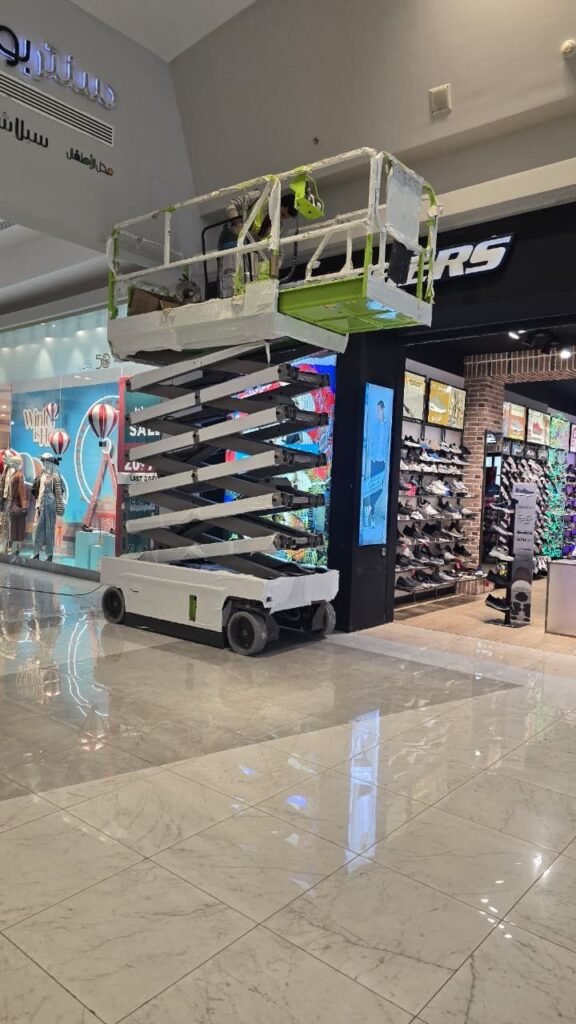
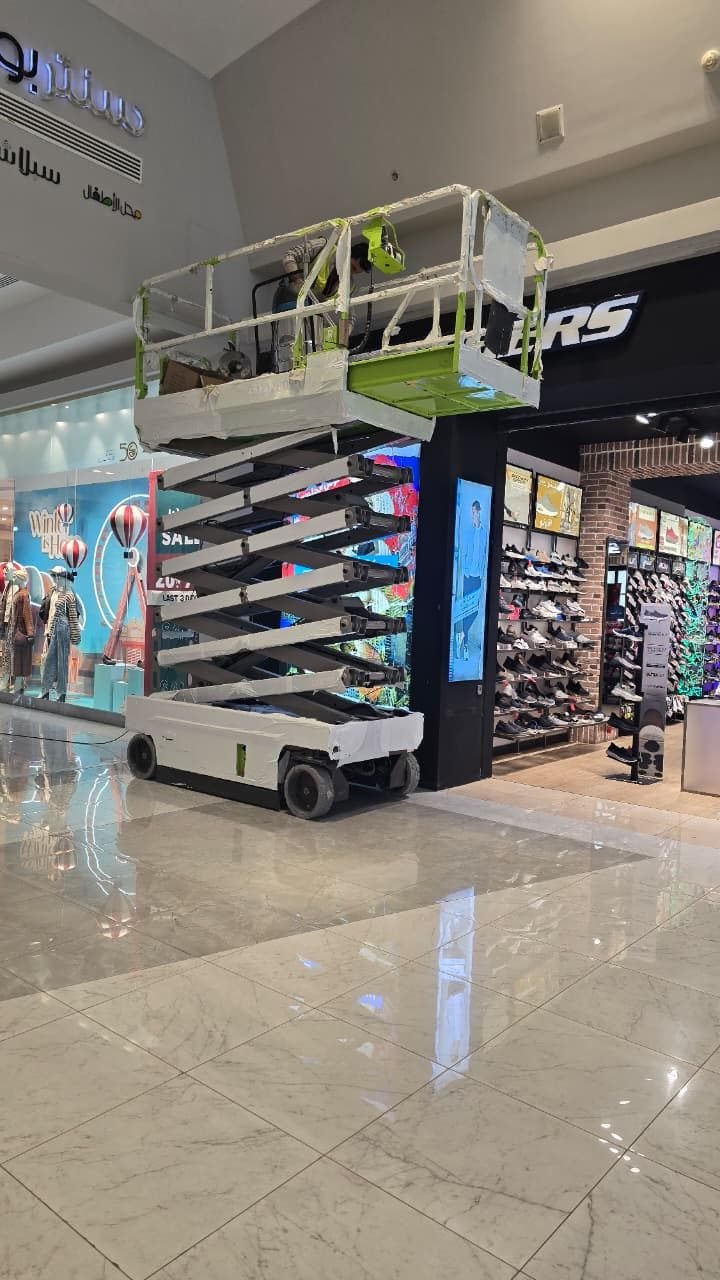
Electric scissor lifts are designed for smooth, level indoor surfaces, offering quiet, zero-emission operation with non-marking tires suited to finished floors in malls, hotels, and warehouses. Rough-terrain scissor lifts use larger, more aggressive tires and diesel or dual-fuel power to handle outdoor and uneven ground conditions typical of construction sites. Choosing between the two isn’t just about power source, it directly affects stability and safety on the surface you’ll actually be working on, so matching the model to your site conditions is essential rather than optional.
Selecting the Right Platform Height
Scissor lift platform heights commonly range from around 6 meters for compact indoor units up to 22 meters or more for larger models used in warehouse racking and high-ceiling facility work. Always calculate your actual reach requirement, which extends beyond the platform height itself once a worker’s arm reach and any tools are factored in, typically adding 1.5 to 2 meters to the platform height figure. Selecting a unit with some margin above your calculated minimum avoids the common problem of running out of reach mid-task and needing to source a taller unit partway through a project.
Common Applications
Scissor lifts are the standard choice for tasks positioned directly above a fixed base point, including ceiling and lighting maintenance, HVAC servicing, warehouse racking installation, signage work, and interior facade or ceiling finishing in retail and hospitality projects. Their flat, spacious platform also makes them practical for tasks requiring two or more workers, or where materials and tools need to be carried up alongside the operator, something narrower platforms like vertical mast lifts can’t accommodate as comfortably.
Floor Loading and Access Considerations
Before booking a scissor lift, confirm the floor loading capacity of your site, particularly for indoor deliveries into upper floors, basements, or older structures where floor load limits may restrict which model can safely be used. Doorway and corridor widths matter too, since larger scissor lifts have a wider base footprint than boom lifts and may not fit through standard doorways, requiring careful route planning for indoor deliveries. Confirming these access details with your rental provider before delivery day avoids the frustrating scenario of a unit arriving on site that simply can’t reach its intended work area.
Safety Essentials
Every scissor lift operator should be trained on load limits, guardrail use, and safe positioning before use, and providers should supply units with current safety inspection records. Overloading the platform beyond its rated capacity is one of the most common safety risks, particularly when workers underestimate the combined weight of personnel, tools, and materials being carried up together. On outdoor or rough-terrain sites, checking ground stability and avoiding operation in high winds are additional standard precautions that should be part of every pre-use check.
What Drives Rental Cost
Scissor lift rental pricing depends primarily on platform height, power type, and rental duration, with monthly rates offering better value than short daily bookings for extended projects. Rough-terrain models generally cost more to rent than equivalent-height electric units, reflecting their more robust construction and outdoor capability. Delivery distance and whether an operator is included will also factor into your final quote, so it’s worth confirming exactly what’s covered before comparing prices across providers.
Frequently Asked Questions
What’s the difference between a scissor lift and a boom lift?
Scissor lifts move straight up and down with a stable, spacious platform, while boom lifts extend outward as well as upward for greater reach around obstacles.
Can scissor lifts be used outdoors?
Yes, rough-terrain models are specifically built for outdoor and uneven ground conditions, while standard electric units are designed for indoor, level surfaces.
How many workers can a scissor lift platform hold?
This depends on the model’s rated capacity, but many mid-size and larger scissor lifts can safely accommodate two or more workers plus tools and materials.
Related Resources
Scissor Lift Rental Hub | Man Lift Rental Guide | Scissor Lift Rental in Riyadh
Need a scissor lift for your project? Contact our team to check availability and get a quote.
Scissor Lifts by Industry
Retail and hospitality businesses across Saudi Arabia rely on electric scissor lifts for the recurring cycle of signage changes, lighting maintenance, and interior refurbishment that keeps stores and hotels current, particularly ahead of major shopping seasons and holiday periods. Facilities management contractors use scissor lifts as their default tool for the bulk of routine building maintenance, from replacing ceiling tiles to servicing overhead building systems in commercial towers. Warehousing operations depend on taller scissor lift models for high-shelf racking installation, inventory audits, and structural maintenance work that sits above the reach of standard order pickers. Construction contractors bring in rough-terrain scissor lifts during the finishing stages of a build, when interior work like drywall, painting, and MEP installation requires stable elevated access across large open floor areas.
Choosing the Right Rental Duration
Short-term daily or weekly scissor lift rentals suit discrete, well-defined tasks like a single signage installation or an isolated repair job where the equipment is only needed for a few days at most. Monthly rentals make more sense for ongoing maintenance programs, multi-phase construction finishing work, or hospitality refurbishment projects that span several weeks, since the per-day cost drops substantially with longer commitments. Businesses with recurring, predictable maintenance cycles often find it worthwhile to negotiate a standing rental arrangement with a trusted provider, ensuring priority access to equipment during their regular maintenance windows rather than competing for availability each time.
Why Fleet Maintenance Quality Matters
Not all rental fleets are maintained to the same standard, and a poorly serviced scissor lift can mean unexpected downtime, delayed inspections, or safety issues that disrupt your project timeline. When evaluating a rental provider, ask about their inspection frequency, how quickly they can replace a faulty unit if one develops an issue mid-rental, and whether their fleet includes recent-model equipment with up-to-date safety features. A provider’s responsiveness to maintenance issues often matters more to your project’s smooth running than the headline rental rate, since downtime from an unreliable unit can cost far more in lost productivity than any savings on the daily rate.
When a Scissor Lift Isn’t the Right Tool
If your task requires reaching over an obstacle, working at an angle away from a fixed base, or accessing a location a straight vertical lift simply can’t reach, a boom lift is usually the better choice despite its higher rental cost. Very low-height indoor tasks in tight spaces may be better served by a compact vertical mast lift, which has a smaller footprint than even the most compact scissor lift. And for genuinely irregular or one-off access needs, sometimes traditional scaffolding remains more practical than any mobile platform, particularly for extended, fixed-position work where a lift would otherwise sit idle in one spot for days. A good rental provider will tell you honestly when a different piece of equipment suits your task better, rather than simply renting you whatever you initially asked for.
Additional FAQ
How quickly can a scissor lift be delivered?
Standard availability allows for delivery within a day or two in most major Saudi cities, though booking further ahead is recommended during peak seasonal demand periods.
Are scissor lifts safe to use near the public in retail or hotel environments?
Yes, with proper barrier placement and scheduling around business hours, scissor lifts are routinely used safely in occupied commercial spaces.
Getting this decision right at the start of a project saves both time and money compared to discovering mid-task that the wrong platform type was chosen.
If you’re unsure which category fits your project, our team can review your task details and recommend the most cost-effective option before you commit to a booking.
Bài chia sẻ chất lượng. Ai đang tìm hiểu du học Hàn Quốc có thể liên hệ Letco — hỗ trợ chọn ngành, học bổng và thủ tục visa nhanh gọn. Chi tiết ở letco.vn.
Pingback: Boom Lift Rental in Saudi Arabia: Complete Guide | Al-Kamil