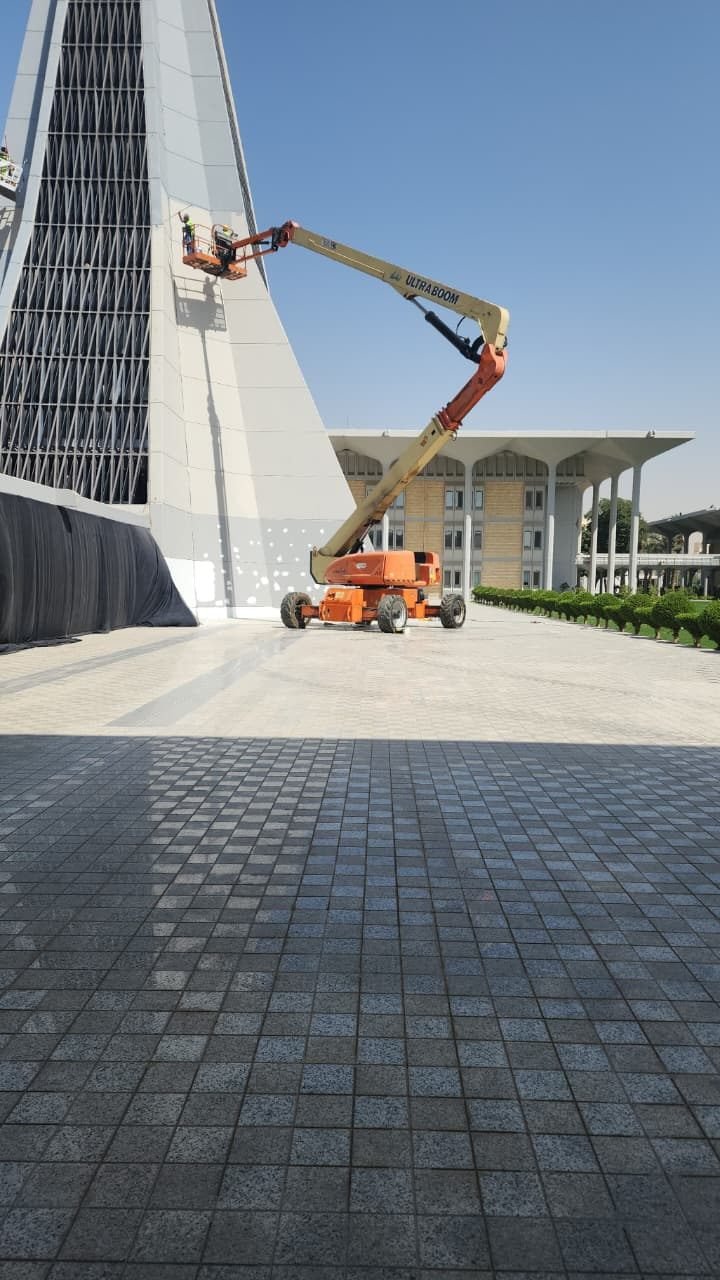
Al-Kamil Forklift Rental supplies articulating and telescopic boom lifts (also called man lifts) for facade work, signage installation, and outdoor construction access across Saudi Arabia. Unlike a scissor lift’s straight vertical movement, a boom lift’s extending arm reaches up, outward, and around obstacles — the right tool whenever your work point isn’t directly above where the machine can stand.
Boom Lift (Man Lift) Rental Overview
A boom lift trades the scissor lift’s larger platform for genuine reach — vertically, horizontally, or both at once. That reach is exactly what you need when a straight-up machine simply can’t get a technician to the work point: around a building corner, over rooftop equipment, or up to a facade section set back from the ground-level footprint. We stock both articulating (multi-jointed) and telescopic (straight-extending) configurations, so we can match the machine to how your specific work point needs to be approached.
Articulating vs. Telescopic Boom Lifts
Articulating boom lifts have multiple jointed sections that bend and fold, letting the platform reach around obstacles, over barriers, or through tight gaps that a straight arm can’t navigate. Telescopic boom lifts extend in a straight line and generally reach further both vertically and horizontally, making them the better choice for open sites where the path to your work point doesn’t need to bend around anything. If you’re not sure which configuration fits your task, describe the obstacle layout at your site and we’ll recommend accordingly.
Understanding Reach and Height
Boom lift specifications list both maximum platform height and maximum horizontal outreach — and for most real jobs, outreach matters just as much as height. A machine with excellent height but limited horizontal reach won’t help if your work point is set back from where the machine can position itself. Describe not just how high you need to go, but how far horizontally the platform needs to extend from the machine’s base, so we can confirm the right model rather than one that falls short on delivery day.
Rough-Terrain vs. Electric Boom Lifts
Rough-terrain boom lifts run on four-wheel-drive chassis built for construction sites, unpaved ground, and outdoor conditions generally. Electric boom lifts suit smoother indoor or paved surfaces where quiet, emission-free operation matters — warehouse interiors, indoor atriums, and finished outdoor areas. Since most boom lift work happens outdoors or on active construction sites, rough-terrain configurations make up the larger share of our fleet, though electric units are available for indoor and light-duty applications.
Rental Terms & Pricing
Daily, weekly, and monthly rental terms are available, with monthly contracts offering the lowest effective daily rate and typically including scheduled maintenance. Every quote separates the rental rate, delivery cost, and operator fee (if requested) into clear line items. For multi-phase construction projects, ask about extending or adjusting your rental term as the project progresses rather than committing to a fixed period upfront.
Safety Requirements
Boom lift operation carries more positioning complexity than a scissor lift, given the extending arm and the ability to work at an angle or offset from the base. Operators should be trained specifically on boom controls, fall protection where the platform requires a harness, and safe clearance from overhead obstacles including power lines — a genuine hazard on many outdoor sites. We walk through safe-operation basics at handover and strongly recommend formal training for teams operating boom lifts regularly.
Common Applications
Construction contractors use boom lifts for facade installation, exterior MEP work, and structural access during multi-story builds. Facilities teams rely on them for exterior building maintenance and glass cleaning on taller structures. Signage and advertising installers use the reach to position and secure elevated signage without scaffolding. And event production teams use boom lifts for rigging and overhead installation work at outdoor venues.
Boom Lift Rental by City
Explore boom lift rental options in your city:
Frequently Asked Questions
What’s the difference between a boom lift and a man lift?
“Man lift” and “boom lift” refer to the same category of equipment — an aerial work platform mounted on an extending arm. We use both terms since clients search for either.
How far can a boom lift reach horizontally?
This varies by model — tell us the horizontal distance from where the machine can stand to your work point, and we’ll confirm a unit with sufficient outreach.
Can a boom lift work near power lines?
Only with proper clearance and precautions. Tell us about any overhead power lines or utilities at your site before your rental begins so we can advise on safe operating distance.
Do you supply an operator with the boom lift?
Yes, available with or without an operator depending on whether your team is already trained on this equipment type.
Get a Boom Lift Rental Quote
Describe your required height, horizontal reach, and site conditions via WhatsApp or call +966 55 936 2375 for a clear quote.
When a Scissor Lift Might Be the Better (Cheaper) Choice
If your work point sits directly above ground level with no obstacles in the way, a scissor lift will usually get the job done at a lower cost and with a larger, more stable working platform. Boom lifts earn their higher rate through reach and flexibility — worth every riyal when you need it, unnecessary expense when you don’t.
Site Access Considerations
Rough-terrain boom lifts are large machines, and access matters as much as capability. Confirm gate widths, ground stability, and any height restrictions (parking structures, overhead cabling) along the delivery route before booking. For sites with genuinely difficult access, mention it upfront — we may be able to recommend a more compact model that still meets your reach requirements without the access headache of a larger unit.
Operator Training and Certification
While boom lifts don’t require the same government-mandated licensing as cranes, the added complexity of boom controls and outreach positioning means operator competence matters more than it does for a straight-up scissor lift. If your team is operating a boom lift for the first time, we strongly recommend accepting our included operator-guidance session at handover, and for ongoing or high-frequency use, investing in formal third-party operator certification pays for itself the first time it prevents an avoidable incident.
Weather and Wind Considerations
Boom lifts, especially at full extension, are more sensitive to wind than scissor lifts due to their higher center of gravity and extended reach. Most manufacturers specify a maximum safe wind speed for operation, and exceeding it — even on a machine that feels stable at ground level — is a genuine tip-over risk. Build weather contingency into outdoor project schedules, particularly for coastal cities or elevated work during shamal wind events, and never treat a wind-speed limit as a suggestion rather than a hard operating boundary.
Multi-Day and Multi-Phase Projects
Construction and facade projects rarely need a boom lift for a single continuous stretch — more often it’s needed intermittently across several project phases. Rather than returning and re-booking the unit each time, ask about flexible monthly terms that keep the machine available on your site (or easily re-delivered) as your project phases require it, without the overhead of re-negotiating a new rental every time work resumes.
Related Guides
Boom Lift Rental: Everything You Need to Know | Man Lift Rental Guide